
If you have $100 sitting in your checking account or buried in a jar on your dresser, you might be looking at it and thinking, “What’s the point?”
We’ve all been conditioned by movies, mainstream media, and Wall Street to believe that investing is a rich man’s game. You picture guys in tailored suits shouting on a trading floor, analyzing complex charts on six monitors, and tossing around hundreds of thousands of dollars at a time. Because of that image, when you only have a hundred bucks, it feels almost insulting to consider investing it. It feels like bringing a teaspoon to a beach and trying to dig a hole to China.
But let me tell you a secret that the financial industry doesn’t want you to know: You don’t need thousands of dollars to start investing. You need a mindset shift.
In fact, starting with $100 might actually be the greatest advantage you have. Why? Because when you have $10,000 to invest, you are terrified of losing it. You make emotional, paranoid decisions. But with $100? The stakes are incredibly low. It gives you the psychological freedom to learn, to make mistakes, and to figure out the system without losing your rent money.
This isn’t an article about getting rich quick. This is a realistic, heavily detailed, step-by-step guide on how to take that crisp $100 bill and plant it in the soil of the financial markets. We are going to cover the psychology of small money, the exact mechanics of where to put it, the math behind why it works, and how to scale it into something life-changing.
Grab a coffee, get comfortable, and let’s change your financial future today.
Chapter 1: The Psychology of the “Too Small” Mindset
Before we talk about stocks, bonds, or apps, we need to talk about what’s happening between your ears. The biggest hurdle standing between you and your first investment isn’t a lack of money; it’s a lack of belief in the power of small beginnings.
The Procrastination Trap Most people suffer from a condition I call “Waiting for the Windfall.” They tell themselves, “I’ll start investing when I get my tax return,” or “I’ll start investing when I pay off my car,” or “I’ll start when I get a raise.”
The problem? Life happens. The tax return goes to a new refrigerator. The car gets paid off, but then the insurance premium jumps. You get a raise, but your lifestyle creeps up to match it. If you wait until you have a “comfortable” amount to start investing, you will never start. Time is the most valuable asset in investing, not money. A dollar invested today is infinitely more powerful than a dollar invested ten years from now.
Reframing the $100 Stop looking at $100 as a final destination. Look at it as a tuition fee.
When you go to college, you pay thousands of dollars for the privilege of learning. When you invest your first $100, you are paying a tiny fee to learn how the stock market actually works. You are paying to learn how to navigate a brokerage app. You are paying to learn how it feels to watch your portfolio go up 2% one day and down 3% the next.
If you lose a little bit of that $100, who cares? You gained an education that you cannot get from reading a book. You gained experience. Once you conquer the fear of pressing the “Buy” button with your first $100, investing $1,000 or $10,000 later becomes practically effortless.
The Ant vs. the Grasshopper Remember the fable of the ant and the grasshopper? The grasshopper played all summer, and the ant worked. But in the modern financial world, the grasshopper doesn’t just play; the grasshopper spends. The ant doesn’t just work; the ant invests.
By deciding to invest $100, you are stepping out of the grasshopper mindset. You are making a conscious declaration that your money is going to work for you, rather than you always working for your money. That psychological shift is worth far more than a hundred bucks.
Chapter 2: Laying the Foundation (The Boring But Crucial Stuff)
I know you want to skip straight to the part where I give you a ticker symbol to buy. But if we build a house on a cracked foundation, it will collapse. Before you invest a single penny, we must run through this checklist.
Rule 1: Do Not Invest Your “Oh Crap” Money If that $100 is the only thing standing between you and an overdraft fee, or if you might need it to buy groceries next week, do not invest it.
Investing requires a time horizon. The stock market goes up and down in the short term. If you are forced to sell your investments at a loss just to pay for a flat tire, investing will have hurt you rather than helped you. Your first financial priority is always a basic emergency fund. Keep your $100 in a high-yield savings account until you have at least a few hundred extra dollars saved up.
Rule 2: Kill the High-Interest Debt Let’s do some brutal math. If you invest $100 in the stock market, historically, you might expect an average return of about 8% to 10% per year. That means in a year, your $100 might grow to $108 or $110.
Now, let’s say you have $100 sitting on a credit card with a 24% APR (Annual Percentage Rate). If you carry that balance, the credit card company is charging you $24 a year just for the privilege of owing them money.
If you invest the $100 while keeping the credit card debt, you are making $10 from the stock market but paying $24 to the credit card company. You are net negative $14. You are running on a financial treadmill going backward.
Exception: If you have low-interest debt (like a mortgage at 4% or a car loan at 3%), you don’t necessarily have to wait to pay it off completely to start investing. The math works in your favor there. But high-interest credit card debt? Kill it first. Use the $100 to pay down the balance. That is a guaranteed, risk-free return on your money.
Rule 3: Define Your “Why” Why are you investing this $100?
- Is it for a house down payment in 5 years?
- Is it for retirement in 30 years?
- Is it just to learn how the system works?
Your “why” dictates your “how.” If you need the money in three years for a wedding, you cannot afford to take much risk. If you need it in 30 years, you can afford to ride out massive stock market crashes because you have decades to recover. For the sake of this article, we are going to assume your $100 is for long-term wealth building (5 to 10+ years) or purely for educational purposes.
Chapter 3: The Magic of Compound Interest (The 8th Wonder of the World)
Albert Einstein allegedly once said, “Compound interest is the eighth wonder of the world. He who understands it, earns it; he who doesn’t, pays it.” Whether Einstein actually said this or not is heavily debated, but the math behind the statement is undeniably true.
To understand why investing $100 matters, you have to understand compounding.
Simple vs. Compound Interest Simple interest is straightforward. If you put $100 in a bank account that pays 5% simple interest, after one year you have $105. After two years, you have $110. You are only ever earning interest on your original $100.
Compound interest is different. It’s interest earning interest. If you invest $100 at a 10% annual return:
- Year 1: You earn $10. Your balance is $110.
- Year 2: You don’t just earn $10 again. You earn 10% on your new balance of $110. So, you earn $11. Your balance is $121.
- Year 3: You earn 10% on $121. That’s $12.10. Your balance is $133.10.
See how the interest earned keeps getting bigger even though you didn’t add a single penny of your own money? That snowball effect is compounding.
The $100 Monthly Scenario Now, let’s look at what happens if you take that initial $100, invest it, and then just add $100 a month to it. Let’s assume a conservative 8% average annual return (which is historically what the S&P 500 averages after adjusting for inflation).
- After Year 1: You invested $1,300 total. Your balance is roughly $1,355.
- After Year 5: You invested $6,100 total. Your balance is roughly $7,400. (That’s $1,300 of free money).
- After Year 10: You invested $12,100 total. Your balance is roughly $18,200. (That’s $6,100 of free money).
- After Year 20: You invested $24,100 total. Your balance is roughly $58,900.
- After Year 30: You invested $36,100 total. Your balance is roughly $140,000.
Look at those numbers closely. By simply automating $100 a month and being patient, you turned $36,000 of your own hard-earned money into $140,000. And nearly $104,000 of that was pure, mathematical compounding.
Your initial $100 is the pebble that starts this avalanche. Without throwing that first pebble, the avalanche never happens.
Chapter 4: Where to Actually Put Your $100 (The Investment Menu)
Alright, the foundation is set, and you understand the math. It’s time to talk about the actual vehicles you can use to invest your $100. You have several options, ranging from completely hands-off to highly active.
Option 1: Fractional Shares (Picking Individual Stocks)
Historically, if you wanted to buy a share of Amazon (AMZN) or Apple (AAPL), you needed hundreds or thousands of dollars because you had to buy a whole share.
Enter the invention of fractional shares.
Major brokerages (like Fidelity, Charles Schwab, Robinhood, and SoFi) realized they were losing out on millennial and Gen Z investors who only had small amounts of money. So, they broke shares into pieces. Now, if Apple is trading at $180 a share, and you only have $50, you can buy roughly 0.27 shares of Apple. You get the exact same percentage gains and dividends as the guy who bought the whole $180 share.
How to use your $100 here: You could pick 3 or 4 companies you deeply believe in and buy $25 to $33 worth of fractional shares in each. The Pros: It’s fun, it’s engaging, and you actually own a piece of companies you use every day. The Cons: It’s risky. If you put your $100 into one company and that company goes bankrupt, your $100 is gone.
Option 2: Exchange Traded Funds (ETFs) and Index Funds (The Smart Way)
If picking individual stocks is like trying to find a needle in a haystack, buying an ETF is like buying the whole haystack.
An ETF (Exchange Traded Fund) is simply a basket of stocks bundled together into one single ticker symbol. The most famous example is an S&P 500 Index Fund. The S&P 500 is a list of the 500 largest, most profitable companies in America (Apple, Microsoft, Amazon, Google, Tesla, etc.).
When you buy a share of an S&P 500 ETF (like VOO or FXAIX), you are essentially buying a tiny sliver of the 500 biggest companies in the US all at once. How to use your $100 here: You take your $100, buy a fractional share of an S&P 500 ETF, and you are instantly diversified across 500 companies. If Apple has a terrible year, but Google has an amazing year, they balance each other out. The Pros: Incredible diversification, historically fantastic returns (averaging 8-10% annually), very low fees. This is the strategy recommended by legendary investors like Warren Buffett. The Cons: It’s “boring.” You won’t get the adrenaline rush of picking a startup that goes to the moon. But boring money is how wealth is actually built.
Option 3: Robo-Advisors (The “Do It For Me” Route)
What if you read the last two options and thought, “I don’t want to pick stocks, and I don’t even want to pick an ETF. Can’t someone just do this for me?”
Yes. Meet the Robo-Advisor.
Platforms like Betterment, Wealthfront, and Acorns use sophisticated algorithms to invest your money for you. You answer a few questions: How old are you? When do you need the money? How scared are you of market crashes?
Based on your answers, the algorithm builds a custom portfolio of ETFs tailored to your exact risk tolerance, and it automatically buys them with your $100. Some, like Acorns, will even round up your everyday purchases (like buying a coffee for $3.50, rounding up to $4.00, and investing the $0.50 difference). How to use your $100 here: You sign up, link your bank, deposit the $100, and let the algorithm take the wheel. The Pros: Zero effort, zero emotional decision-making, automatic rebalancing. The Cons: Robo-advisors charge a small fee (usually around 0.25% of your balance per year). On $100, this is literally pennies, but as your wealth grows, the fees add up compared to just buying an ETF yourself.
Option 4: Retirement Accounts (The Tax-Advantaged Route)
If your $100 is for the long-term (meaning you won’t touch it until you are 59 ½ years old), you should consider putting it into a retirement account like a Roth IRA.
When you invest in a normal brokerage account, if your $100 grows to $500 and you sell it, you have to pay taxes on that $400 profit. In a Roth IRA, you put in money that you’ve already paid taxes on (your $100 from your paycheck). Because you already paid the tax, all the growth is 100% tax-free forever. If that $100 grows to $500, or $5,000, or $500,000 in a Roth IRA, and you pull it out at retirement, you pay zero taxes on it.
How to use your $100 here: You open a Roth IRA at a brokerage like Fidelity or Vanguard, deposit your $100, and buy an ETF inside the account. The Pros: Massive tax savings over your lifetime. The Cons: Your money is locked up. If you need that $100 back next year to buy a car, you’ll face penalties and taxes for pulling it out of a Roth IRA early.
Option 5: Alternative Investments (Investing in Yourself)
This is the wildcard option, and honestly, for someone who only has $100 to their name, it might be the most lucrative option on the table.
The stock market will give you an 8-10% return. But what if you could get a 1,000% return? You can, if you invest in your ability to earn more money.
Instead of buying stocks with your $100, you could:
- Buy a domain name and start a niche blog or business. ($12/year for the domain, $10/month for cheap hosting).
- Buy a highly-rated online course on a skill like copywriting, graphic design, SEO, or video editing on platforms like Udemy or Coursera.
- Buy books written by experts in an industry you want to break into.
- Pay for a premium subscription to a job board or networking platform.
If you spend $100 learning how to write sales copy, and that skill lands you a freelance gig that pays you $500, you just got a 400% return on your $100 in a matter of weeks. No stock market can touch that.
Chapter 5: The Step-by-Step Execution Plan
Enough theory. Let’s get into the literal clicks. If you have $100 right now and you want it invested in the stock market by the end of the day, here is exactly how you do it.
For this walkthrough, I am going to recommend using a standard, zero-fee brokerage like Fidelity, Charles Schwab, or Robinhood. (I do not get paid by them; they are just the industry standard for beginners due to $0 account minimums and $0 commission fees).
Step 1: Download the App and Open an Account Download the app on your phone or go to their website. Click “Open an Account.” You will need to provide your Social Security Number (this is legally required for tax reporting; don’t worry, it’s secure), your address, and your employment info.
Step 2: Choose Your Account Type The app will ask: “Individual Brokerage” or “Roth IRA”?
- If this money is for retirement and you won’t touch it for decades, click Roth IRA.
- If this is just to learn, or you might need the money in a few years for a house or a trip, click Individual Brokerage.
Step 3: Link Your Bank The app will ask you to log into your checking account using your bank’s username and password (through a secure third-party service like Plaid). This allows you to transfer money back and forth.
Step 4: Transfer the $100 Initiate a transfer of $100 from your checking account to your new brokerage account. Depending on the broker, this might take 2 to 4 business days to clear. (Some brokers offer “instant buying power” where they front you the money while the transfer processes, but let’s assume you wait the few days for it to be safe).
Step 5: The Moment of Truth — Buying Once the $100 shows up as “Available to Trade,” it’s go time.
- Tap the search bar at the bottom of the screen.
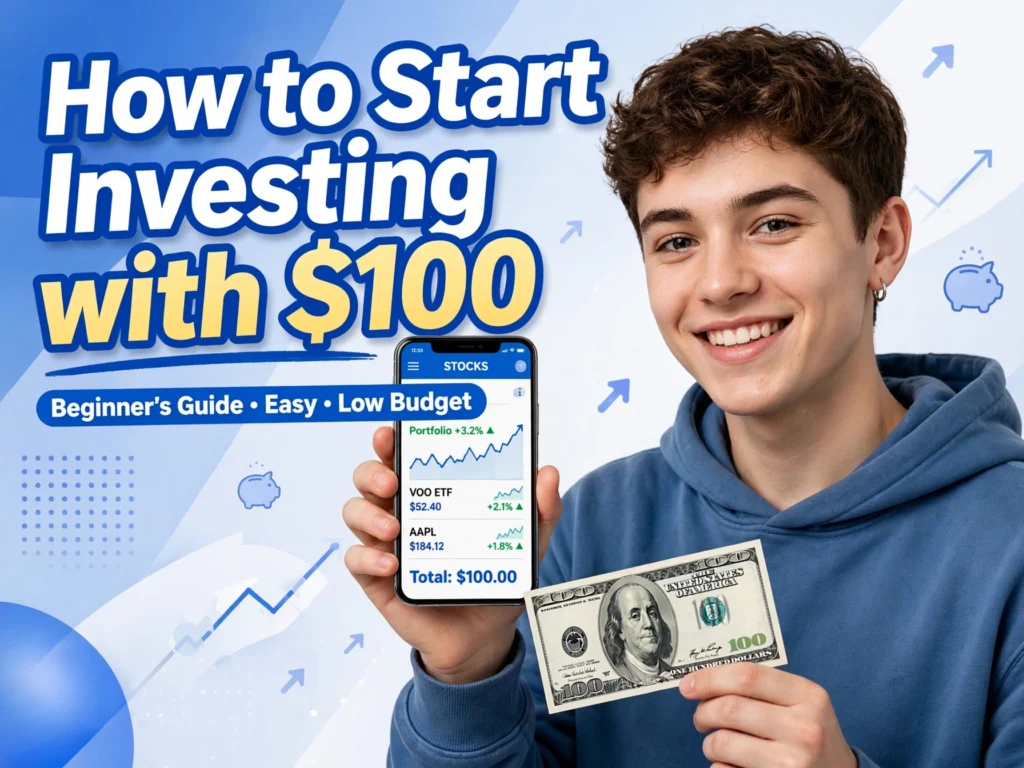
- Type in a broad market ETF. If you are on Fidelity, type FXAIX or FSKAX. If you are on Robinhood or Schwab, type VOO or VTI.
- Tap on the ticker symbol.
- You will see a big green button that says “Buy.”
- Tap it.
- It will ask for an amount. Type in 100.
- Select “Market Order” (this means you are buying it at the current market price right this second, rather than trying to set a specific price limit).
- Review the order and swipe to confirm.
Boom. You are officially an investor. You own a piece of the global economy. Take a screenshot. Go tell a friend. Celebrate the fact that you are no longer just a consumer; you are an owner.
Chapter 6: What Happens Next? (Managing the Psychology of the Market)
Pressing the “Buy” button is the easiest part of investing. The hardest part is what happens in the weeks, months, and years that follow. You need a mental armor to survive the financial markets.
The First Week: The Dopamine Hit When you buy your first $100 worth of an ETF, you will probably check your phone every three hours to see what it’s doing. If the market is up, you’ll feel like a genius. You’ll start calculating in your head: “If it makes 2% a day, I’ll be a millionaire by Christmas!”
Reality check: The stock market does not go up 2% a day. Enjoy the dopamine, but don’t get used to it.
The First Month: The Reality Check Eventually, the market will have a bad day. Or a bad week. You will open your app and see that your $100 is now $94.
This is the exact moment where 90% of beginners panic and sell. They think, “I knew it! Investing is a scam! I’m losing my money!”
Here is what you need to understand: Paper losses are not real losses until you sell. If you bought a house for $300,000, and the next year Zillow says it’s worth $280,000, you wouldn’t put a “For Sale” sign in your yard in a panic. You’d wait it out because you plan to live in the house for 20 years. Treat your investments the exact same way.
The stock market is a volatile beast in the short term. It reacts to news, elections, interest rates, and sometimes just the mood of traders on a Tuesday. But in the long term, the stock market always trends upward because human progress always moves forward. Companies will continue to invent things, sell things, and make money.
The First Year: The Danger of Boredom After a year, your $100 might be worth $108. It won’t feel very exciting. You might look at crypto investors on Twitter who made 500% on some random coin and feel like a fool for earning a measly $8.
Do not fall for the comparison trap. The lottery winners get all the headlines, but the slow and steady investors get all the wealth. That $8 you made was made while you were sleeping, while you were at work, while you were watching Netflix. You did absolutely nothing productive to earn it. That is the beauty of passive investing.
Chapter 7: Scaling Up – The $100 a Month Blueprint
We started this conversation talking about a one-time $100 investment. But as we discussed in the compound interest chapter, the real magic happens when investing becomes a habit.
How do you scale from a one-time $100 to a consistent wealth-building machine? You have to automate the process. Human willpower is flawed. We intend to save money at the end of the month, but then we see a pair of shoes on sale, or we get invited out to dinner, and suddenly the money is gone.
Pay Yourself First The golden rule of personal finance is to pay yourself first. When your paycheck hits your bank account, the first bill you pay should be to your future self.
Set Up Auto-Investing Almost every modern brokerage allows you to set up “Recurring Investments.” You can tell the app: “Every single Friday, automatically take $25 out of my checking account and buy $25 worth of VOO.”
By doing this, you never have to think about it. You never have to log in and press “Buy.” You never have to look at the market and wonder if it’s a “good time” to buy. (Hint: It’s almost always a good time to buy if your time horizon is 10+ years).
You are dollar-cost averaging. Sometimes your $25 will buy shares when the market is high. Sometimes your $25 will buy more shares when the market is on sale (low). Over time, this averages out your purchase price and drastically reduces your risk.
Where to Find the Extra $100? You might be reading this and thinking, “I don’t have an extra $100 a month to invest. I live paycheck to paycheck.” I empathize with that. The cost of living is brutally high right now. But often, we have hidden money leaks in our budget.
- The Subscription Audit: Go through your bank statement for the last month. Are you paying $15 for a streaming service you haven’t watched in a month? Cancel it. That’s $15 toward investing.
- The Coffee Factor: I hate the phrase “stop buying coffee to get rich,” because life is meant to be enjoyed. But if you buy a $6 latte every single workday, that’s $120 a month. What if you bought a nice coffee maker and made coffee at home 3 out of 5 days? You just found $70 a month.
- The 24-Hour Rule: Implement a rule where if you want to buy something non-essential that costs more than $30, you have to wait 24 hours. 50% of the time, the urge will pass, and that money stays in your account.
- Sell Your Clutter: We all have clothes we don’t wear, old video games, or electronics gathering dust. Spend a weekend listing items on Facebook Marketplace or Poshmark. Take that $100 and make it your initial investment seed.
Chapter 8: The Pitfalls — What to Avoid at All Costs
When you are operating with small amounts of money, you are highly vulnerable to scams, predatory fees, and your own emotional mistakes. You must navigate these minefields carefully.
Pitfall 1: Penny Stocks and “Get Rich Quick” Schemes You have $100. You see a TikTok video of a guy claiming a certain stock trading at $0.003 is about to “go to the moon” and make you a millionaire.
Penny stocks are unregulated, highly manipulated, and incredibly dangerous. They are often companies that are essentially bankrupt. The people promoting them on social media usually bought them at an even lower price, and they are using your $100 to pump the price up so they can sell their shares and leave you holding the bag.
Pitfall 2: High-Fee Mutual Funds If you go to a traditional bank and ask to invest $100, they might try to put you in a mutual fund with a 1.5% “load” (a fee just to buy it) and a 1% annual expense ratio. On $100, a 1% fee is $1 a year. Who cares, right? You should care. Over 30 years, that 1% fee will eat up literally tens of thousands of dollars of your potential wealth due to the lost compounding. Always look for ETFs with expense ratios of 0.03% to 0.10%.
Pitfall 3: Day Trading Day trading is the act of buying and selling stocks multiple times a day, trying to profit off tiny price movements. It requires staring at screens, understanding complex chart patterns (candlesticks, moving averages, Bollinger bands), and possessing the emotional discipline of a cyborg.
Studies show that roughly 97% of day traders lose money over the long run. The 3% who make money are usually backed by hedge funds with supercomputers. With $100, you cannot compete with them. Do not try. Be a long-term investor, not a short-term gambler.
Pitfall 4: Cryptocurrency as an “Investment” (For Beginners) I am not anti-crypto. However, buying things like Dogecoin or Shiba Inu with your last $100 is not investing; it’s speculation. Crypto does not produce earnings, it does not pay dividends, and its value is derived purely from what the next person is willing to pay for it. If you want to put $10 of your $100 into Bitcoin just to learn how crypto wallets work, that’s fine. But do not treat highly volatile digital assets as a core retirement strategy when you are just starting out.
Chapter 9: Real-Life Case Studies (How the $100 Story Actually Plays Out)
To bring all this information to life, let’s look at three fictional, but highly realistic, examples of how different people might deploy their first $100.
Case Study 1: Sarah, The Set-and-Forget Investor Sarah is 24. She just got her first corporate job. She has $100 left over after paying her bills. She opens a Roth IRA on Fidelity. She buys $100 worth of an S&P 500 index fund. She sets up an automatic transfer of $100 from every paycheck to go into that same fund. 10 Years Later: Sarah is 34. The market has had ups and downs, including a global pandemic and a recession. But she never stopped her $100 bi-weekly contributions. She didn’t panic sell. Her account balance is now over $18,000. Because it’s in a Roth IRA, every single penny of that growth is completely tax-free.
Case Study 2: Mike, The Self-Education Investor Mike is 30 and works in retail. He wants to change careers but doesn’t have a degree. He takes his $100 and buys two highly-rated courses on Udemy about digital marketing and Google Ads. He spends two weeks studying at night after his shifts. 6 Months Later: Mike uses his new knowledge to build a small portfolio of freelance work. He lands a contract managing a local business’s Google Ads for $500 a month. That initial $100 didn’t go into the stock market, but it acted as venture capital for his own human capital. His income has permanently increased.
Case Study 3: Elena, The Emotional Beginner Elena is 22. She takes her $100, downloads a trading app, and uses it to buy a hot tech stock that everyone on Reddit is talking about. She checks it obsessively. Two weeks later, the company reports bad earnings, and the stock drops 40%. Her $100 is now $60. Panicked, she sells the stock. She concludes that “investing is rigged” and never invests again. She misses out on a decade of compounding because she took on too much risk with money she wasn’t mentally prepared to lose, and she didn’t understand the asset she was buying.
Which one of these stories do you want to be?
Chapter 10: Advanced Concepts to Grow Into
As your $100 turns into $1,000, and then $10,000, your strategy will naturally evolve. Here are a few concepts you can start reading about today so you are ready when your wealth grows.
Asset Allocation This is the mix of stocks, bonds, and cash you hold. Generally, the younger you are, the more stocks you should own (because you have time to recover from crashes), and the older you get, the more bonds you should own (because bonds are safer and provide steady income). A common rule of thumb is “110 minus your age equals the percentage of your portfolio that should be in stocks.” So if you are 20, 90% stocks, 10% bonds.
Tax-Loss Harvesting This is a strategy where, if a stock you own goes down in value, you intentionally sell it at a loss to offset the taxes you might owe on stocks that went up in value. It sounds counterintuitive to sell at a loss on purpose, but it can save you thousands of dollars in taxes over your lifetime. Many robo-advisors do this automatically for you.
Dividend Reinvestment Plans (DRIPs) Some companies pay you a portion of their profits just for owning the stock. This is called a dividend. If you own a stock that pays a $2 dividend, you can take that $2 as cash, OR you can tell your broker to automatically use that $2 to buy more fractional shares of that same stock. This is called a DRIP, and it radically accelerates the compounding process.
International Diversification While the S&P 500 is great, it only contains US companies. As you grow your portfolio, you might want to look into “Total World” ETFs (like VT) which own stocks from the US, Europe, Asia, and emerging markets, giving you a literal stake in the entire global economy.
Chapter 11: Answering Your Most Pressing FAQs
Let’s address the final lingering doubts you might have.
Q: What if the stock market crashes tomorrow and I lose my $100? A: If you invested in a broad ETF, a market crash means your $100 might temporarily drop to $80. It feels bad, but remember, you haven’t actually lost anything unless you sell. The stock market has historically crashed every 5 to 7 years on average. It is a normal part of the economic cycle. If you hold on, the market has always recovered and gone on to hit new all-time highs.
Q: Is $100 really enough to make a difference? A: Mathematically, $100 by itself will not make you rich. But the habit of investing $100 is what makes you rich. This first $100 is about breaking the seal. Once you see how easy it is, you will find ways to invest $200, then $500. The $100 is the spark that starts the fire.
Q: Do I have to pay taxes on my $100 investment? A: Not until you sell it at a profit. If you buy $100 worth of an ETF, and it grows to $150, you owe zero taxes while you hold it. You only pay “Capital Gains Tax” in the year that you click the “Sell” button and realize that $50 profit. (And if it’s in a Roth IRA, you pay zero taxes even when you sell).
Q: What if I don’t have $100 right now, but I have $20? A: The exact same rules apply. You can buy $20 worth of a fractional share ETF. Do not let perfect be the enemy of good. Start with whatever you have.
Q: How long does it take to double my $100? A: You can use the “Rule of 72” to figure this out. Divide 72 by your expected annual return. If you expect an 8% return, 72 divided by 8 = 9. It will take roughly 9 years for your $100 to turn into $200 without you adding another penny.
Conclusion: The Greatest Cost is Inaction
We have covered a massive amount of ground in this guide. We’ve talked about the psychology of money, the brutal reality of compound interest, the exact mechanics of brokerage accounts, the dangers of penny stocks, and the power of automated investing.
But ultimately, all of this information is completely useless if you close this tab and do nothing.
The greatest risk you can take in your financial life is not investing in the stock market. The greatest risk is inaction. Inflation is a silent thief that is constantly eroding the purchasing power of the dollars sitting in your checking account. Every day you wait, your money loses a little bit of its value.
You don’t need to be a math genius. You don’t need to wear a suit. You don’t need to watch CNBC. You just need a smartphone, a bank account, and $100.
By starting small, you are insulating yourself from the panic that ruins wealthy investors. You are buying your education on the cheap. You are planting a seed that, with consistent watering, will grow into a tree that provides shade for you and your family for decades to come.
Stop waiting for the perfect moment. The perfect moment is now. Stop waiting for a windfall. You are the windfall.
Take that $100. Open the app. Buy the ETF.
Congratulations. You’re an investor. Welcome to the game.