Let’s be brutally honest for a second. If you’ve spent any time online in the last year, you’re suffering from AI fatigue.
Every time you open your phone, there’s a new headline: “ChatGPT just passed the bar exam!” “Claude can read a whole book in three seconds!” “Gemini can watch a video and understand what’s happening!”
It’s overwhelming. It feels like you’re standing on a racetrack while three different Formula 1 cars are revving their engines, and you’re expected to pick which one to drive to work. You don’t want to read a dry, technical whitepaper comparing token limits and parameter counts. You want someone to cut through the marketing hype, sit down with you, and explain in plain English: What’s the actual difference between these things, and which one is going to make my life easier?
That’s exactly what we’re going to do here.
This isn’t a quick 500-word listicle. This is a deep, comprehensive, human-to-human breakdown of the three titans of the artificial intelligence world: OpenAI’s ChatGPT, Anthropic’s Claude, and Google’s Gemini. We’re going to rip off the hood, look at the engines, and figure out what makes each of them tick.
More importantly, we’re going to look at how they think, how they handle your specific everyday tasks, and ultimately, which one deserves a permanent spot on your browser’s bookmark bar.
So, grab a coffee, get comfortable, and let’s settle this.
Part 1: The Philosophy – Why These AIs Are So Different
Before we talk about features, we have to talk about philosophy. This is the most overlooked part of the AI conversation, but it’s the secret to understanding why these bots act so differently.
Imagine you’re hiring an assistant.
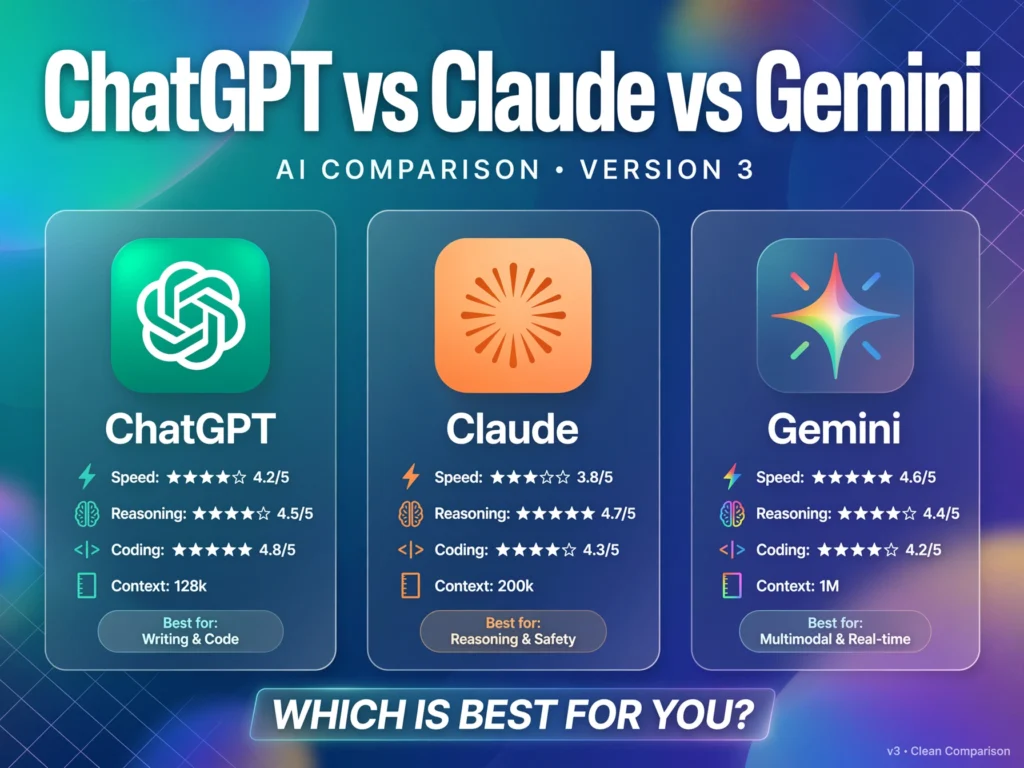
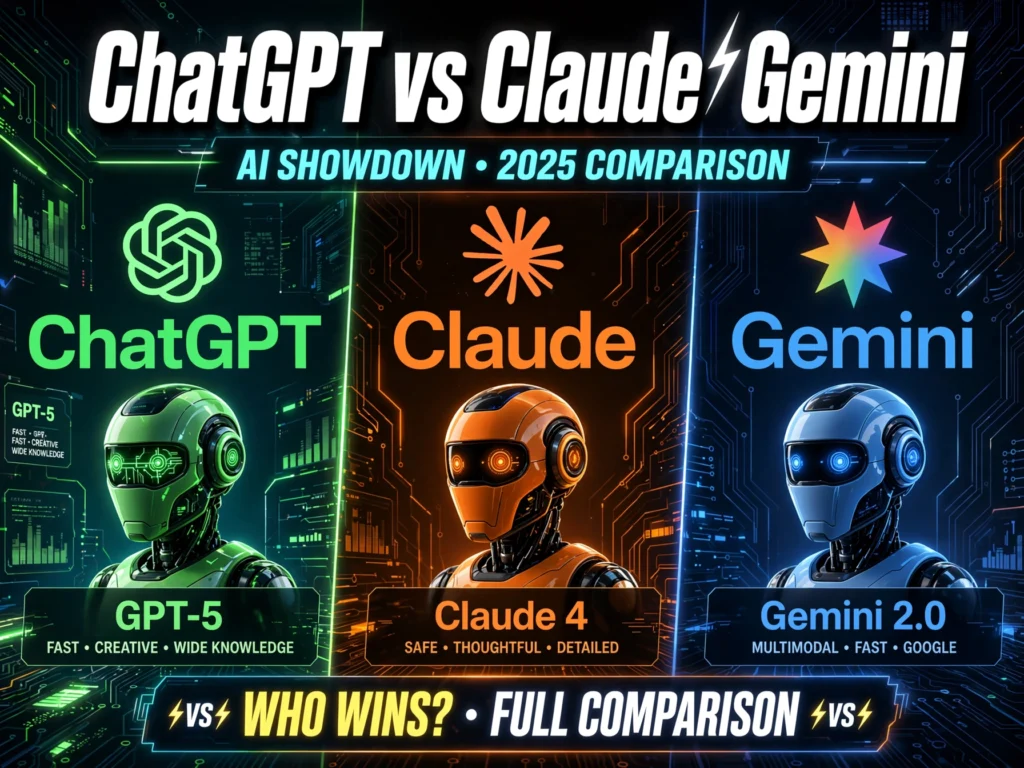
ChatGPT (OpenAI) is the overeager, hyper-competent college intern. They’ve read every book in the library, they type at a million words a minute, and they will immediately start building a powerpoint presentation before you even finish your sentence. They might get a little too enthusiastic sometimes and make stuff up to impress you, but man, do they get things done.
Claude (Anthropic) is the seasoned, thoughtful researcher. They listen to your entire request, pause, and then give you a highly nuanced, carefully worded response. They won’t just give you the answer; they’ll point out the flaws in your question. They are deeply concerned with not stepping on landmines (giving you dangerous or incorrect info), even if it means they talk a little slower.
Gemini (Google) is the connected librarian who has access to every live news feed, database, and YouTube video on the planet. If you need to know what the weather is right now, or what a specific celebrity wore to an event ten minutes ago, the intern and the researcher can’t help you. But the librarian? They know, because they are plugged directly into the pulse of the world.
These personalities aren’t accidents. They are the direct result of how these companies train their models.
OpenAI went for scale and speed. Anthropic went for safety and nuance (a concept they call “Constitutional AI”). Google went for deep, multimodal integration with the internet.
Keeping these personalities in mind will make the rest of this guide make perfect sense.
Part 2: ChatGPT – The Default King
It’s impossible to talk about AI without starting with ChatGPT. It is the iPhone of artificial intelligence. It wasn’t the first smartphone, but it was the one that changed the world. When it launched in November 2022, it broke the internet. It showed regular people that machines could actually hold a conversation.
The Origins
Built by OpenAI (a company heavily backed by Microsoft), ChatGPT is based on the “GPT” (Generative Pre-trained Transformer) architecture. It started as a text-only tool, but it has rapidly evolved into a multimodal monster.
What It Does Best
1. The “Do Anything” Versatility ChatGPT’s biggest strength is its sheer breadth. It is the ultimate generalist. Whether you want it to write a Python script to scrape a website, draft a sarcastic email to your boss, or create a meal plan based on the random ingredients in your fridge, ChatGPT handles it all with惊人的 competence. It has a massive “world knowledge” base that spans almost every industry.
2. The Plugin and Ecosystem Advantage Because ChatGPT got to the market first, it has the largest ecosystem. With a Plus subscription ($20/month), you get access to custom GPTs. These are mini-applications built by the community. You can click a button and instantly load a GPT specifically designed to be a legal assistant, a logo designer, or a data analysis tool. No other AI has an app store quite like this yet.
3. Advanced Voice Mode If you haven’t tried ChatGPT’s Advanced Voice mode on your phone, you are missing out on a sci-fi experience. It doesn’t just speak to you; it breathes, it laughs, it adjusts its tone based on your inflection. It can understand accents, background noise, and even interpret your emotions. For practicing a language, brainstorming out loud, or just having a conversational sounding board, it is unmatched.
Where It Falls Down
1. The “Lazy” Phase and Hallucinations ChatGPT wants to please you. This is its greatest flaw. If it doesn’t know the answer, it will often confidently invent one (a hallucination). Furthermore, the model has gone through phases where it gets “lazy.” You’ll ask it to write a 1000-word article, and it will write 500 words and say, “I’ll stop here, you can continue it!” It tries to do the least amount of work possible to satisfy the prompt.
2. The “AI Sound” Because everyone uses ChatGPT, everyone’s writing is starting to sound the same. It relies heavily on certain transition words (“Furthermore,” “Moreover,” “In conclusion,” “Delve”). If you use ChatGPT for public-facing copy without heavily editing it, people will instantly know it’s AI-generated.
3. Context Limits (Historically) While GPT-4o has improved drastically, ChatGPT has historically struggled to remember things you told it an hour ago in a long chat session. It has a habit of “forgetting” instructions buried deep in a conversation.
Who Should Use ChatGPT?
If you are a tinkerer, a coder, someone who needs an all-in-one swiss army knife, or someone who wants to build custom AI workflows, ChatGPT is still the gold standard. It’s the best choice for 80% of everyday tasks simply because it has seen more data on how humans ask for things than anything else on earth.
Part 3: Claude – The Writer’s Best Friend
Anthropic was founded by former Vice Presidents of Research at OpenAI. They looked at ChatGPT and said, “This is great, but it’s too reckless. We can build something safer and more intuitive.” The result was Claude.
I’ll be completely transparent: for long-form writing, coding logic, and deep analysis, Claude is my personal favorite. Once you use it for a week, going back to ChatGPT can feel clunky.
The Origins
Anthropic trained Claude using something called “Constitutional AI.” Instead of just feeding it data and hoping for the best, they gave Claude a “constitution”—a set of rules about how to behave. They taught it to be helpful, harmless, and honest (the three H’s). They actively trained it to say “I don’t know” instead of making things up.
What It Does Best
1. Unmatched Writing Quality If ChatGPT writes like a competent corporate intern, Claude writes like a skilled author. Claude understands subtext, tone, and pacing far better than its rivals. If you ask Claude to write a blog post, it doesn’t immediately hit you with bullet points and bold text. It writes in a natural, flowing, paragraph-by-paragraph style that sounds remarkably human. It avoids the cliché “AI words” that ChatGPT relies on.
2. The Massive Context Window (Claude 3.5 Sonnet / Opus) This is Claude’s superpower. Imagine you have a 300-page PDF of a legal contract, a textbook, or a company’s entire financial history. You can upload the whole thing to Claude, and it will actually read and understand all of it. ChatGPT used to choke on documents this large, but Claude handles massive context windows effortlessly. You can say, “Find the clause in this 200-page document that talks about early termination, and summarize it,” and Claude will do it perfectly.
3. Nuance and Safety Claude is much harder to “jailbreak” (trick into saying bad things) than ChatGPT. It has a much better moral compass. If you ask Claude a complex ethical question, it will give you a beautifully balanced answer that looks at the issue from multiple sides, rather than just giving you a black-and-white response.
4. Coding Logic and Debugging While ChatGPT is great for writing quick scripts, Claude is incredible at taking a broken piece of code, understanding the architecture, and explaining why it’s broken. It thinks step-by-step in a way that feels more rigorous.
Where It Falls Down
1. The “Hallucination of Humility” Because Claude is trained to be so safe, it sometimes refuses to do perfectly harmless things. You might ask it to write a fictional story about a bank robbery, and it might give you a lecture on the ethics of theft before finally writing a watered-down version of your prompt. It can be incredibly frustrating when it puts up unnecessary guardrails.
2. Less Multimodal Muscle While Claude can analyze images and charts now, it is not nearly as advanced as Gemini or ChatGPT in this area. You can’t generate images with Claude (you have to use an external tool like Midjourney or DALL-E). It is fundamentally a text-first, text-focused machine.
3. Smaller Ecosystem Anthropic is a smaller company. They don’t have the massive “Custom GPT” store that OpenAI has. The interface is clean and minimalist (which many people prefer), but if you want little add-ons and plugins, Claude isn’t the place for it.
Who Should Use Claude?
If you are a writer, a novelist, a student writing essays, a lawyer reviewing contracts, or a programmer debugging complex logic, Claude is your go-to. If you are tired of text that sounds like a robot, Claude is the cure.
Part 4: Gemini – The Connected Giant
Google was caught with its pants down when ChatGPT launched. As the company that essentially invented the underlying technology for modern AI (the Transformer architecture, way back in 2017), they were deeply embarrassed.
They rushed out a chatbot called “Bard,” which famously gave a wrong answer in its very first public demo, costing Google billions in stock value. But Google didn’t give up. They went back to the lab, merged their AI divisions (DeepMind and Google Brain), and rebranded everything under the name Gemini.
Make no mistake: Google is playing the long game, and Gemini is terrifyingly powerful because it’s not just a chatbot; it’s connected to the entire internet.
The Origins
Unlike ChatGPT and Claude, which started as text and added media later, Gemini was built from the ground up to be “natively multimodal.” It was designed to look at text, images, audio, and video all at the same time, treating them as equal parts of a single puzzle.
What It Does Best
1. Real-Time Web Access and Google Integration This is the kill feature. If you ask ChatGPT or Claude (on their free tiers) about a news story that happened an hour ago, they will apologize and say their knowledge cutoff is last year. Gemini knows what happened an hour ago because it is directly plugged into Google Search.
Furthermore, if you use Gemini inside the Google Workspace ecosystem (Google Docs, Gmail, Google Drive), it is magical. You can open a Google Doc containing your meeting notes, click the Gemini icon, and say, “Turn these messy notes into a professional email to the client.” It reads your specific file and does it instantly.
2. Video and Audio Comprehension Gemini’s ability to process video is mind-bending. You can upload a 10-minute YouTube video of a complicated physics lecture, and ask Gemini, “At the 4:32 mark, what equation did the professor write on the board, and did he make any mistakes?” Gemini will watch the video, find the exact timestamp, and analyze the visual data. Neither ChatGPT nor Claude can do this with that level of precision.
3. The “Google Lens” Synergy Gemini is deeply integrated into Android phones via Google Lens. You can point your camera at a broken appliance, a strange plant in your yard, or a menu in a foreign language, and Gemini instantly overlays information about what you are looking at. It bridges the digital and physical world better than anyone else.
4. Deep Research Capabilities Google recently introduced “Deep Research” in Gemini Advanced. You give it a complex topic (e.g., “Compare the economic policies of the 1980s to today”), and Gemini doesn’t just spit out an answer. It goes away, searches the web, reads dozens of articles, compiles a massive report, and presents it to you with citations. It acts like a human research assistant spending hours on a project.
Where It Falls Down
1. The “Google Plex” Problem Google is an advertising company. Because of this, Gemini can sometimes feel like it’s trying to funnel you toward Google products. The user interface can be confusing because there are different versions of Gemini floating around (Gemini Nano on your phone, Gemini Pro on the web, Gemini Ultra for advanced users). It’s not as simple as “downloading the app.”
2. Inconsistent “Vibe” in Chat When it comes to just having a casual, back-and-forth text conversation, Gemini can feel a bit… weird. It lacks the conversational warmth of Claude and the snappy directness of ChatGPT. It can sometimes give you long, overly structured responses when you just wanted a quick, simple answer. It feels more like a search engine with a personality than a true conversational partner.
3. Historical Inaccuracies Because Gemini is so deeply tied to the live web, it can sometimes prioritize SEO-optimized garbage over factual accuracy. While Claude might say “I don’t know,” Gemini might confidently scrape a wrong answer from a random blog and present it as fact.
Who Should Use Gemini?
If you are a researcher, a student doing deep-dive projects, someone who needs real-time news and data, or someone who lives entirely inside the Google Workspace ecosystem (Docs, Sheets, Drive), Gemini is an absolute powerhouse. It is the ultimate information retrieval tool.
Part 5: The Head-to-Head Showdown (Real-World Scenarios)
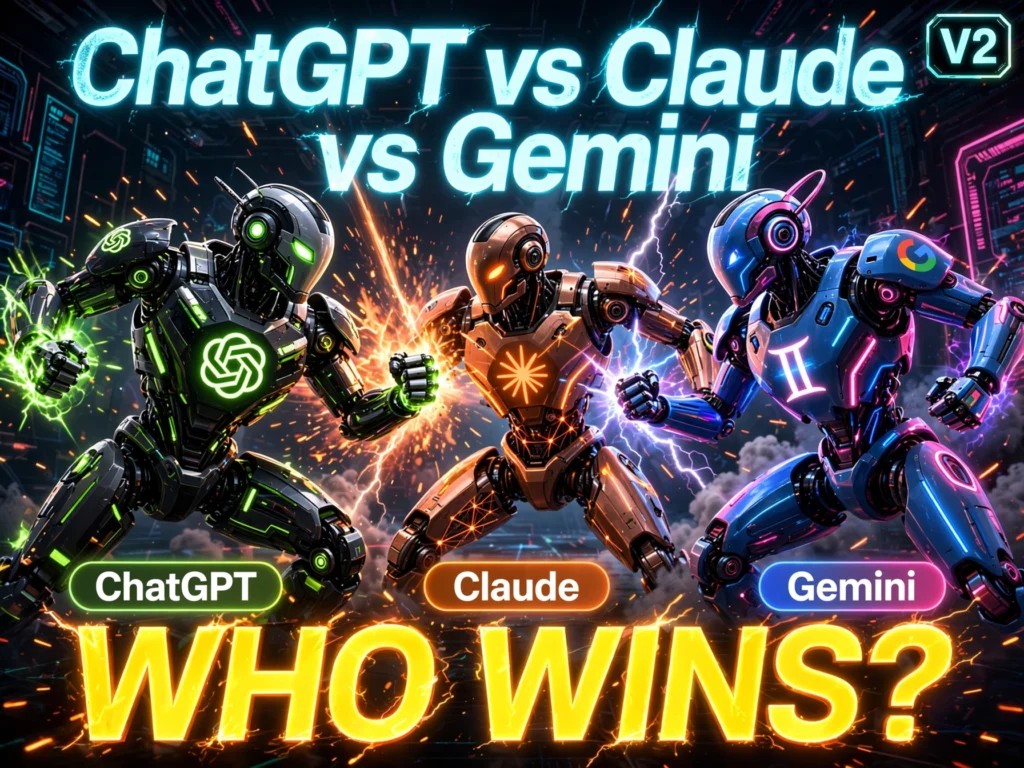
Theory is great, but how do these bots handle the exact same prompts? Let’s put them in the ring together.
Scenario 1: The Creative Writing Test
Prompt: “Write a 300-word short story about a detective who realizes the killer is his own reflection in the mirror, but don’t make it cliché. Focus on sensory details.”
- ChatGPT: Writes a competent story. It will probably use the words “chilling,” “abyss,” or “labyrinth.” The structure will be very standard: intro, twist, conclusion. It reads like a decent episode of a generic TV show.
- Claude: Writes a literary story. It will focus on the smell of stale coffee, the flicker of the fluorescent light, the way the pupils dilate. The twist will feel earned and psychological. Claude understands how to build dread without relying on cheap horror tropes.
- Gemini: Might struggle a bit with the “don’t make it cliché” constraint. It might lean heavily into standard detective noir tropes because it’s scraping the internet, where that style is most prevalent.
Winner: Claude. It’s not even close.
Scenario 2: The Complex Coding Task
Prompt: “I have a Python script that scrapes weather data. It’s throwing a ‘KeyError’ on line 42 when the wind speed is missing from the JSON response. Here is the code… [paste code]. Fix it and explain why it broke.”
- ChatGPT: Will quickly spot the missing key, wrap it in a
.get()method or atry/exceptblock, and give you the fixed code. It’s fast and accurate. - Claude: Will spot the error, but it will also look at the rest of your code and say, “By the way, your API call on line 10 is also inefficient, and you should probably add a sleep timer so you don’t get rate-limited by the weather API.” Claude fixes the immediate bug and anticipates the next three bugs.
- Gemini: Will likely search the web for the specific weather API’s documentation, read it, and then give you a fix that perfectly aligns with the API’s best practices.
Winner: Tie between Claude (for deep logic) and Gemini (for API-specific documentation). ChatGPT is a close second for pure speed.
Scenario 3: Real-Time Fact Finding
Prompt: “What were the top three trending topics on Twitter/X this morning, and give me a one-paragraph summary of why each is trending?”
- ChatGPT (Free): “I’m sorry, but I don’t have access to real-time data…”
- Claude (Free): “As an AI, I don’t have live internet access…” (Note: Claude Pro can use tools to search, but it’s not native like Gemini).
- Gemini: Instantly pulls data from Google Trends and live web searches. Gives you the three topics, complete with up-to-the-minute summaries and links to news articles.
Winner: Gemini. By a landslide.
Scenario 4: Document Analysis
Prompt: [Upload a 150-page PDF of a rental lease agreement] “Find every clause related to early termination, and list the exact financial penalties for leaving at month 6 versus month 12.”
- ChatGPT: Might struggle to read the whole thing at once (depending on the version), or it might hallucinate a penalty because it didn’t actually read page 84.
- Claude: Devours the 150 pages in seconds. It will cite the exact page numbers (e.g., “On page 43, Section 4B states…”) and extract the financial penalties with spreadsheet-like accuracy.
- Gemini: Will do a good job, but might get distracted by formatting issues or headers in the PDF.
Winner: Claude. Its massive context window makes it the undisputed king of reading long documents.
Part 6: The Pricing Breakdown – What Do They Actually Cost?
Let’s talk money. All three offer free tiers, but to really see them stretch their legs, you have to pay. Here is how the pricing structures compare (as of late 2024).
ChatGPT Plus ($20/month) For $20, you get access to GPT-4o (their most powerful model), the Advanced Voice mode, DALL-E 3 (image generation), and the Custom GPT store. It is the most “value-dense” subscription because you get text, voice, and images all in one place.
Claude Pro ($20/month) For $20, you get access to Claude 3.5 Sonnet and Claude 3 Opus (their heavy-duty reasoning model). You get a significantly larger context window than the free tier, priority access when the servers are busy, and the ability to create “Projects” (where you can upload specific files and instructions that Claude permanently remembers).
Gemini Advanced ($20/month) For $20, you get access to Gemini 1.5 Pro, the Deep Research feature, and—here is the kicker—it comes bundled with Google One AI Premium. This means your $20 also gives you 2TB of cloud storage for your Google Drive/Gmail, and it integrates the AI directly into your Docs, Sheets, and Slides. If you already pay for cloud storage, this is practically free.
The Verdict on Pricing: If you want the best all-in-one creative/coding tool, pay for ChatGPT. If you read and write massive amounts of text, pay for Claude. If you use Google Workspace for your job, pay for Gemini (it’s an absolute steal because of the 2TB storage included).
Part 7: The Elephant in the Room – Privacy and Data Scraping
You cannot talk about AI without talking about what happens to your data. When you pour your company’s secrets, your private journals, or your client’s financial data into these chatbots, who owns it?
This is where the differences are stark and highly important.
OpenAI (ChatGPT): By default, OpenAI uses your chats to train their future models. If you are a free user, you must explicitly opt out of this. If you are a ChatGPT Plus or Team user, you can go into the settings and turn off “Chat history & training,” which stops them from using your data. However, many privacy advocates remain wary of OpenAI’s close ties to Microsoft and their broader corporate data policies.
Anthropic (Claude): Anthropic has taken a much stronger stance on privacy from the beginning. They explicitly state that they do not use your user inputs or conversations to train their models unless you explicitly opt-in (and even then, the system is built around strict data isolation). For businesses dealing with sensitive legal or medical data, Claude is generally considered the safest bet.
Google (Gemini): Google’s privacy policy is… complex. If you use Gemini as part of Google Workspace (meaning your company pays for a Google account), Google explicitly states they do not use your data to train their models. You are safe. However, if you are just a regular consumer using your personal Gmail account to chat with the free version of Gemini, Google may review your conversations to “improve their services” (i.e., train the AI). Given that Google is an advertising company built on data harvesting, many hyper-privacy-conscious users avoid putting sensitive personal info into Gemini.
The Verdict on Privacy: Claude wins for general consumer trust. Workspace Gemini wins for enterprise safety. ChatGPT requires you to dig through settings to protect yourself.
Part 8: The “Uncanny Valley” of AI and Why It Matters
There is a psychological concept called the “Uncanny Valley.” It’s the point where something looks almost perfectly human, but there’s a tiny, imperceptible flaw that makes your brain scream “That’s not a real person!”
Right now, AI text is deep in the Uncanny Valley.
People are developing “AI radar.” You can just tell when an email, a blog post, or a product description was written by ChatGPT. It uses too many adjectives. It apologizes too much (“As an AI language model…”). It structures things in identical ways.
This is a crucial factor in deciding which AI to use.
If your goal is to generate a first draft that you are going to heavily edit and rewrite, ChatGPT is fine. It gives you the raw clay.
But if you want something that feels closer to a finished product—something that sounds like a thoughtful human being actually sat down and typed it out—Claude is vastly superior. Claude’s training makes it mimic human cadence, pacing, and idiosyncrasies much better. It’s willing to use incomplete sentences. It’s willing to be a little dry or a little witty without forcing it.
Gemini falls somewhere in the middle. It often writes like a very knowledgeable Wikipedia article, which is great for information, but terrible for storytelling.
If you are using AI to communicate with other humans (sales emails, marketing copy, personal essays), you must choose the tool that gets you out of the Uncanny Valley fastest. Right now, that’s Claude.
Part 9: Behind the Scenes – How Do They Actually “Think”?
Let’s take a brief, non-technical look at the engines under the hood. They all use the same basic architecture (the Transformer, invented by Google in 2017), but they process information differently.
Think of an AI model like a giant game of Mad Libs, but on a supercomputer.
When you type a prompt, the AI doesn’t “understand” it the way a human does. It turns your words into numbers. It then looks at the numbers, looks at the massive database of text it was trained on, and calculates the mathematical probability of which word should come next.
You type: “The cat sat on the…” The AI calculates: Based on billions of pages of text, the word “mat” has an 89% probability of following that sequence. “Couch” has a 5% probability. “Moon” has a 0.0001% probability.
It picks “mat.” It does this for every single word, millions of times per second.
Where they differ is in “Alignment.” Once the base model is built (the Mad Libs engine), it is wildly unpredictable. It might output toxic garbage, or it might write a poem. The companies have to “align” the model to be a helpful assistant.
- OpenAI uses RLHF (Reinforcement Learning from Human Feedback). They had thousands of humans sit at computers, give the AI a prompt, and rate the AI’s answers. “Answer A was good, give it a cookie. Answer B was bad, zap it.” This made ChatGPT highly obedient and eager to please, but it also made it a bit of a sycophant (it tells you what you want to hear).
- Anthropic uses Constitutional AI. Instead of humans rating every answer, Anthropic gave the AI a set of rules (the Constitution) and had another AI act as a judge. Claude judges itself against its own rules. This is why Claude feels more introspective and less eager to just agree with you.
- Google uses a mix of RLHF and massive web-scale data. Google tuned Gemini to be exceptionally good at following specific formatting instructions (like “output this as a JSON file” or “create a table with 5 columns”).
Understanding this explains why ChatGPT agrees with you even when you are wrong, Claude pushes back when you are wrong, and Gemini gives you exactly what you asked for in a highly structured format.
Part 10: The Future – Where Is This Going?
This article will be outdated in six months. That is the reality of this industry. But looking at the trajectories, we can see where each company is heading.
The ChatGPT Trajectory: The AI Agent OpenAI is moving toward “Agents.” Right now, you ask ChatGPT to do one thing, it does it, and stops. OpenAI wants ChatGPT to be an Agent. Soon, you will say, “Plan a trip to Tokyo for me for next month.” ChatGPT won’t just give you an itinerary. It will autonomously go to Expedia, check flight prices, book the flight, email you the confirmation, add it to your calendar, and suggest restaurants near your hotel. It will do things, not just talk about things.
The Claude Trajectory: The Flawless Colleague Anthropic is obsessed with reliability. Their future goal is eliminating hallucinations entirely. They want Claude to be a tool that lawyers, doctors, and accountants can trust with 100% certainty. They are focusing on making Claude’s reasoning transparent—meaning when Claude gives you an answer, it can show you the exact step-by-step logic it used to get there, so you can verify its work.
The Gemini Trajectory: The Ubiquitous OS Google doesn’t want Gemini to be a website you visit. They want Gemini to be the underlying operating system of your entire digital life. You’ll wake up, your phone will have listened to your alarm and your sleep patterns, Gemini will have cross-referenced your calendar, and it will say, “Good morning. You have a meeting at 9, but traffic is bad. I already started your car and routed you a different way. Also, I noticed you were snoring more, here is an article about sleep apnea.” Gemini wants to be ambient intelligence.
Part 11: How to Build Your “AI Stack” (The Real Secret)
Here is the dirty little secret the tech blogs won’t tell you: You don’t have to pick just one.
Power users don’t treat these AIs like rival sports teams. They treat them like tools in a toolbox. You don’t use a hammer to drive a screw, and you don’t use a screwdriver to pound a nail.
I use all three, multiple times a day, for different things. Here is what a modern “AI Stack” looks like:
- For quick questions, brainstorming, and image generation: I open ChatGPT. It’s fast, it’s versatile, and DALL-E 3 is great for making silly little images for my presentations.
- For writing articles, editing long documents, or reading PDFs: I switch to Claude. I upload my rough drafts, and I use a prompt like: “Edit this for flow, remove any AI-sounding cliches, and make the tone more conversational.” Claude never disappoints.
- For real-time research, analyzing YouTube videos, or working in Google Docs: I fire up Gemini. If I need to know what the current interest rate is, or I need to pull data from three different websites, Gemini handles the live web better than anyone.
If you are only going to pay for one, look at your life. Are you a writer? Get Claude. Are you a coder/tinkerer? Get ChatGPT. Are you a researcher/Google Workspace user? Get Gemini.
Part 12: Final Thoughts – The Human Element
As we wrap up this massive deep-dive, it’s important to step back and look at the big picture.
We are spending a lot of time comparing machines. We are obsessing over token limits and context windows and multimodal capabilities. But we need to remember what these tools actually are: mirrors.
ChatGPT, Claude, and Gemini do not have ideas. They only have statistical probabilities based on human ideas. Every brilliant thought an AI has ever generated was originally conceived by a human being somewhere in the past. The AI just rearranged the pieces.
This means that the quality of the output is entirely dependent on the quality of your input.
A bad prompt will yield a bad result, regardless of whether you are using the most advanced supercomputer on earth or a magic 8-ball. The skill of the 21st century is not “knowing how to use AI.” It is knowing how to ask good questions. It is critical thinking. It is the ability to look at a block of text generated by Claude and say, “This is good, but it’s missing the human element. Let me add my own experience to this.”
ChatGPT is the fast-talking genius. Claude is the thoughtful writer. Gemini is the connected oracle.
They are all magnificent pieces of technology that would have seemed like literal magic just ten years ago. Don’t get paralyzed by the choice. Pick the one that sounds most interesting to you right now. Go to their website. Create a free account.
Type in the first thing that comes to your mind.
Watch the cursor blink, and watch the words appear. That feeling of awe—that realization that you are having a conversation with a machine that can synthesize all of human knowledge in seconds—never really gets old.
The AI revolution isn’t coming next year. It’s here. The only question left is: what are you going to ask it?