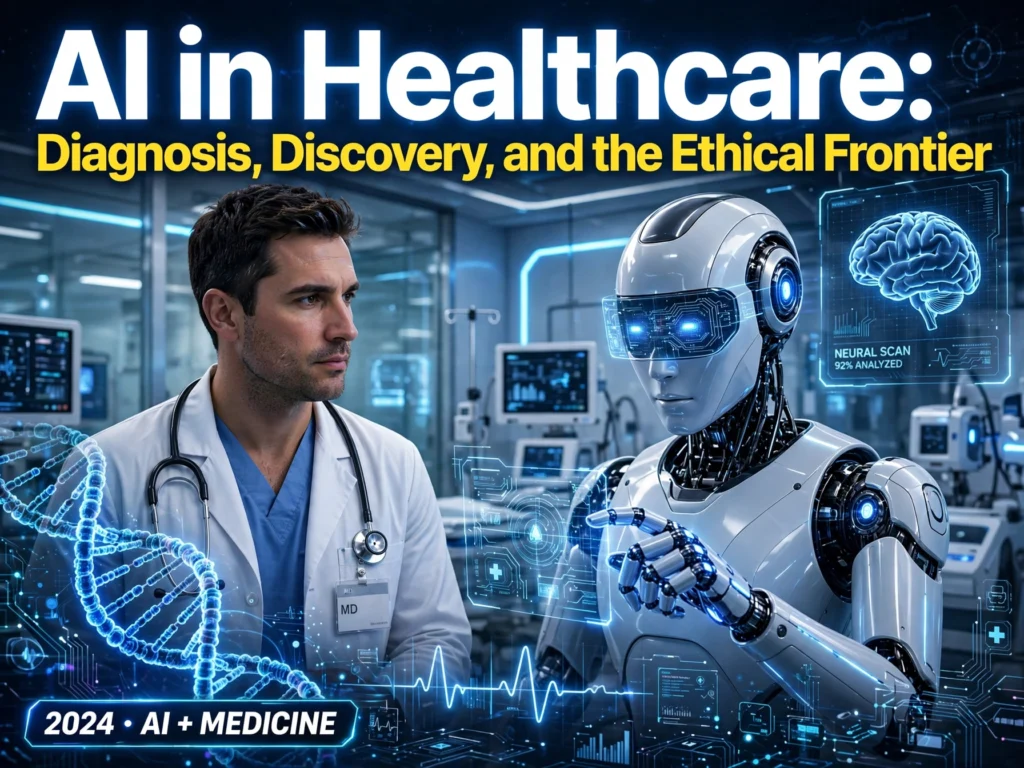
Imagine walking into a hospital where your diagnosis is cross-checked by an artificial intelligence system that can spot microscopic anomalies the human eye might miss. Or, imagine a world where life-saving drugs are developed in a fraction of the time it takes today. This isn’t a scene from a science fiction movie anymore; it is the reality of modern medicine.
Artificial intelligence is rapidly transforming the healthcare landscape, shifting from experimental tech to essential clinical tools. In this post, we will explore some of the most compelling AI in healthcare examples, from revolutionizing medical imaging to accelerating drug discovery, while also taking a critical look at the ethical and regulatory challenges that come with these advancements.
Seeing the Unseen: AI Medical Diagnosis and Radiology
One of the most promising applications of artificial intelligence in medicine is in the field of medical imaging. AI medical diagnosis tools, particularly those utilizing computer vision, are proving to be game-changers.
Outperforming the Human Eye
Traditionally, radiologists spend countless hours scanning X-rays, MRIs, and CT scans to detect early signs of diseases like cancer. While human radiologists are highly skilled, fatigue and the sheer volume of scans can lead to oversights.
Enter AI radiology. Computer vision algorithms can be trained on millions of medical images, learning to recognize the subtle patterns of tumors, fractures, or bleeding. In several recent studies, AI systems have successfully detected breast cancer and lung cancer years before human radiologists could spot them on the scans.
But this doesn’t mean AI is replacing doctors. Instead, AI acts as a tireless “second pair of eyes.” By flagging high-risk areas on a scan, AI helps radiologists prioritize urgent cases and confirm their diagnoses with greater confidence, ultimately leading to earlier interventions and better patient survival rates.
From Years to Months: The Revolution of AI Drug Discovery
Developing a new drug is traditionally a grueling process that can take 10 to 15 years and cost billions of dollars. Most of this time is spent in the discovery phase, trying to understand how biological targets—like proteins—function and how a potential drug molecule might interact with them.
Cracking the Protein Code
This is where AI drug discovery is making massive waves. In 2020, an AI system called AlphaFold (developed by DeepMind) solved one of biology’s grand challenges: predicting the 3D structure of proteins from their amino acid sequences.
Why does this matter? Because proteins are the engines of disease. If you know exactly what a disease-causing protein looks like, you can design a drug that perfectly binds to it, neutralizing it. By utilizing AI, researchers can simulate millions of molecular interactions in days rather than years.
Today, pharmaceutical companies are using AI to identify existing drugs that could be repurposed for new diseases, design novel molecules from scratch, and drastically shorten the timeline for bringing a new, life-saving medication to clinical trials.
The Black Box Problem: Ethics in AI Healthcare
While the future of AI in medicine looks incredibly bright, it is not without significant hurdles. The most pressing ethical concern is the “black box” problem.
When the Machine Can’t Explain Itself
Deep learning models, the technology behind most advanced AI, operate in ways that even their creators don’t fully understand. The system takes in vast amounts of data, processes it through complex neural networks, and spits out a prediction (e.g., “98% probability of malignant tumor”).
The problem? The AI cannot explain why it made that prediction. In healthcare, the “why” is critical. If an AI recommends a dangerous surgical procedure or heavy chemotherapy, doctors need to know the clinical reasoning behind the recommendation. If the AI is wrong and harms a patient, who is responsible? The doctor? The hospital? The software developer?
Until AI systems can provide explainable, transparent reasoning for their medical decisions, the black box problem will remain a significant barrier to full clinical autonomy.
Navigating the Red Tape: FDA Regulatory Hurdles
Beyond ethics, there is the formidable challenge of regulation. In the United States, the Food and Drug Administration (FDA) is responsible for ensuring medical devices are safe and effective. But AI doesn’t fit neatly into traditional regulatory frameworks.
Regulating a Moving Target
Historically, the FDA approves a medical device based on a static snapshot of its performance. If a pacemaker is approved, the physical device doesn’t change.
However, modern AI is designed to continuously learn and adapt. An AI diagnostic tool might perform well during its FDA approval process, but as it is deployed in hospitals and learns from new, diverse patient data, its performance will shift. How does the FDA regulate an algorithm that is constantly evolving?
The FDA is currently working on a framework for “Predetermined Change Control Plans” to address this, allowing developers to outline how their AI will evolve and how they will monitor it for safety. However, balancing rapid technological innovation with patient safety remains a delicate and ongoing struggle.
Conclusion
The integration of artificial intelligence into medicine is not a distant dream—it is happening right now. From AI radiology catching cancer earlier than ever before to AI drug discovery bringing new treatments to market at unprecedented speeds, the benefits are undeniable.
However, as we look toward the future of AI in medicine, we must approach this technology with cautious optimism. Solving the black box problem and establishing robust regulatory frameworks are just as important as the algorithms themselves. Ultimately, the goal of AI in healthcare is not to replace the human touch of doctors, but to empower them with better tools, ensuring a healthier future for all of us.
What are your thoughts on AI in the medical field? Would you trust an AI diagnosis? Let us know in the comments below!