
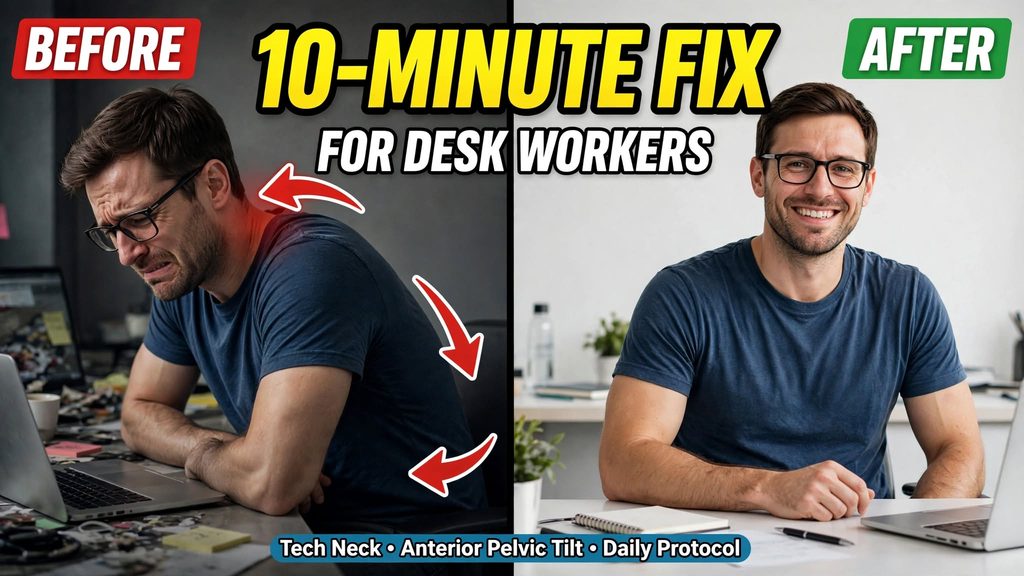
Desk jobs are the primary culprit behind a modern posture epidemic, with tech neck (forward head posture) and anterior pelvic tilt (APT) being two of the most common results. These conditions stem from the “default outcome of modern desk life,” where prolonged sitting tightens the hip flexors and weakens the glutes, while constant screen time overstretches the neck extensors.
To correct these imbalances, you need a two-part strategy: immediate workspace adjustments and a consistent exercise routine.
🛠️ Your Immediate Workspace Fix
Posture is not about rigidly sitting straight—it’s about keeping your spine in a balanced position. Adjust your workspace to prevent your body from fighting the setup.
| Element | Correct Setup | Why It Matters |
|---|---|---|
| Chair | Use a chair with real lumbar support. Adjust the height so your feet rest flat on the floor and your hips and knees are roughly level. | Prevents the pelvis from rolling backward, which pulls the low back into a slouched posture. |
| Monitor | The top of the screen should be at eye level and at an arm’s length away. | Looking down at a laptop screen is a direct cause of tech neck. |
| Desk & Keyboard | Elbows should be bent at a 90-degree angle with your hands falling naturally in front of you. | Reaching forward for the keyboard tightens the chest and causes the shoulders to round. |
| Habits | Set a timer to stand up and move every 30 minutes. | Short “movement snacks” prevent muscle stiffness and help reset your spine. |
🏃 The 10-Minute Corrective Routine
Exercise is a prescription for healthy posture. The goal is to strengthen weak muscles (like glutes and deep neck flexors) and stretch tight ones (like hip flexors and chest). This routine takes about 10 minutes and can be done daily.
Part 1: Fixing Tech Neck (Forward Head)
Tech neck occurs because the deep neck flexors become underactive and weak. The exercises below are designed to re-engage these muscles and improve head control.
- Chin Tucks: Draw your head straight back over your shoulders to create a subtle “double chin,” without tilting your head up or down. Hold for 3 seconds. Start with 5-10 reps, done frequently throughout the day.
- Wall Angels: Stand flat against a wall, pressing your spine into it. Raise your arms to form a ‘W’ shape, then slowly slide them up to a ‘Y’ shape. Do 10 slow reps to strengthen your scapular stabilisers and open up the shoulders .
- Doorway Chest Opener: Place your forearm on a doorframe at 90 degrees. Step forward slightly until you feel a stretch in your chest. Hold for 30 seconds per side to counteract the hunched position from sitting .
Part 2: Fixing Anterior Pelvic Tilt (Lower Back Arch)
APT is caused by a muscle imbalance where the hip flexors are tight and the glutes are weak. To reset your pelvis, focus on the exercises below.
- Couch Stretch: Kneel in front of a couch with one foot on it. Squeeze the glutes to feel a deep stretch in the front of the hip. Hold for 60 seconds per side. This is often considered the #1 stretch for anterior pelvic tilt .
- Glute Bridge: Lie on your back with your knees bent and feet flat on the floor. Power your hips towards the ceiling, holding the top position for a few seconds while squeezing your glutes. Aim for 3 sets of 15 reps .
- Bird-Dog: Get on your hands and knees. Extend one arm forward while extending the opposite leg behind you, keeping your core tight. Aim for 2 sets of 12 reps per side. This enhances core stability and promotes spinal alignment .
📈 Tracking Your Progress
You won’t fix a posture pattern built over years by just standing up straight. Stretching alone is often not enough; your body needs to learn a new pattern through consistent work.
- Expectations: Most people feel changes within 6 to 8 visits to a physical therapist, but full posture retraining can take 3 to 6 months of consistent work.
- Key Metric: The best indicator is your daily improvement in pain levels and your ability to hold a neutral position. “Better posture is not about doing more. It’s about doing the right things consistently”.
⚠️ When to Seek Professional Help
If you experience persistent pain, stiffness, or postural imbalances, seeking professional help can provide tailored exercises and hands-on treatment. An osteopath or physiotherapist can assess your movement patterns, release tension, and guide you toward long-term postural health .
FAQ
Q: How often should I do this routine?
A: Aim for daily consistency. Short, frequent mobility sessions improve posture more than weekly long sessions .
Q: What is the most impactful daily habit for body alignment?
A: Ergonomic desk setup delivers the highest return because it protects alignment during the longest sustained activity of most workdays .
Q: Is exercise for posture enough on its own?
A: No. Exercise for posture builds strength and mobility, but postural muscles respond to the positions you hold most often. Without supporting daily habits, 8–10 hours of sitting can gradually reverse your workout gains .
Q: Are there other exercises to help with rounded shoulders?
A: Yes. Band pull-aparts are excellent for targeting the mid-back muscles and countering rounded shoulders. Grab a band, stand tall, and pull the band as wide as you can while opening your chest. Aim for 3 sets of 12 reps