
Have you ever asked an AI to write something for you, only to receive a robotic, inaccurate, or completely unhelpful response? If so, you are not alone.
The secret to getting incredible results from artificial intelligence isn’t about having the most expensive software; it is about how you talk to it. Welcome to the world of prompt engineering.
In this comprehensive prompt engineering guide, we are going to move beyond basic tips like “be specific.” Whether you are a marketer, a student, or a business owner, learning how to write good prompts will completely change how you work. We will explore a proven AI prompt framework, look at real ChatGPT prompt examples, and dive into advanced techniques like chain of thought prompting.
Let’s dive in and learn how to communicate effectively with large language models (LLMs).
What is Prompt Engineering?
At its core, prompt engineering is the art and science of designing inputs that guide an AI to produce the exact output you want. Think of an LLM (like ChatGPT, Claude, or Gemini) as a brilliant but incredibly literal intern. If you give them vague instructions, they will guess what you mean—and they might guess wrong.
Prompt engineering is about removing the guesswork. It is a systematic approach to structuring your requests so that the AI understands your intent, your constraints, and your desired outcome.
The Ultimate AI Prompt Framework: PCTF
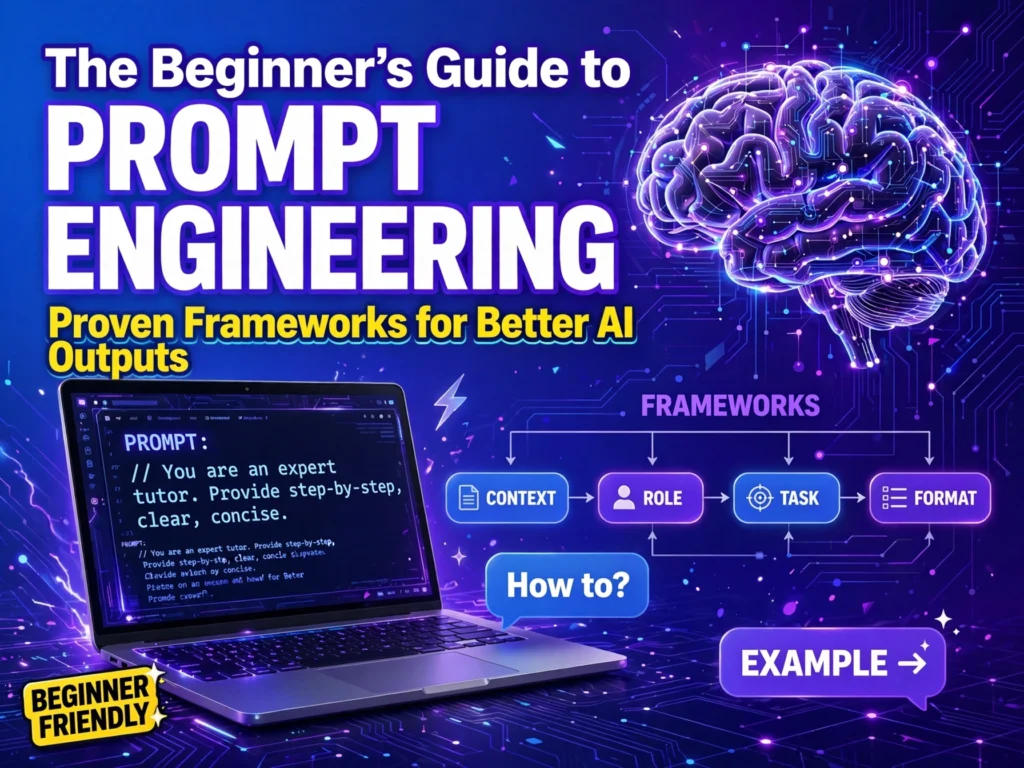
When people struggle with AI, it is usually because they treat it like a Google search bar. Instead, you should treat it like a conversation with an expert. To do this reliably, use the PCTF framework: Persona, Context, Task, and Format.
Using an AI prompt framework ensures you never leave out crucial details. Let’s break it down:
1. Persona
Tell the AI who it should be. By assigning a role, you immediately calibrate the AI’s vocabulary, tone, and expertise level.
- Example: “Act as a senior digital marketing strategist with 15 years of experience.”
2. Context
Provide the background information. The AI doesn’t know your business, your audience, or your goals unless you tell it.
- Example: “I am launching a new eco-friendly water bottle aimed at college students who care about sustainability but are on a tight budget.”
3. Task
This is the actual action you want the AI to perform. Be as specific as possible.
- Example: “Write three different Facebook ad headlines and one primary text description for this product.”
4. Format
Specify exactly how you want the information presented. Do you want a table, bullet points, a 500-word essay, or a JSON file?
- Example: “Format the output as a table with two columns: ‘Headline’ and ‘Primary Text’. Keep the tone upbeat and conversational.”
Putting It All Together
Instead of typing: “Write an ad for a water bottle.”
You type:
“Act as a senior digital marketing strategist (Persona). I am launching a new eco-friendly water bottle aimed at college students who care about sustainability but are on a tight budget (Context). Write three different Facebook ad headlines and one primary text description for this product (Task). Format the output as a table with two columns: ‘Headline’ and ‘Primary Text’. Keep the tone upbeat and conversational (Format).”
The difference in the output quality will blow your mind.
Real-World ChatGPT Prompt Examples
To help you visualize the PCTF framework in action, here are a few more ChatGPT prompt examples for different use cases:
Example 1: Learning a New Skill
“Act as a patient computer science professor (Persona). I am a complete beginner who wants to learn Python for data analysis, but I have no prior coding experience (Context). Explain what a ‘dictionary’ is in Python (Task). Use a simple real-world analogy, and format your explanation with bullet points for key terms (Format).”
Example 2: Content Repurposing
“Act as an expert social media manager (Persona). I run a personal finance blog helping millennials get out of debt (Context). Take the following 1,000-word blog post I wrote about budgeting and extract the top 5 tips (Task). Turn these tips into 5 separate Twitter threads. Each thread should have an engaging hook and 5 tweets (Format).”
Advanced Technique: Chain of Thought Prompting
Sometimes, an AI needs to “think” before it speaks. This is especially true for complex logic puzzles, math problems, or multi-step reasoning tasks. This is where chain of thought prompting comes in.
When you ask an AI a complex question, it might rush to an incorrect answer because it tries to predict the final word immediately. By forcing the AI to lay out its reasoning step-by-step, you drastically reduce errors and hallucinations.
How to Use Chain of Thought Prompting
It is incredibly simple. You just need to add a specific phrase to your prompt, such as:
- “Think step by step.”
- “Let’s think logically about this step by step before giving the final answer.”
- “Outline your reasoning before providing the conclusion.”
Example Without Chain of Thought:
“If I have 5 apples, give 2 to a friend, buy 5 more, and then split them evenly among 3 people, how many does each person get?” (The AI might output a wrong number because it tries to calculate everything at once).
Example With Chain of Thought Prompting:
“If I have 5 apples, give 2 to a friend, buy 5 more, and then split them evenly among 3 people, how many does each person get? Let’s work through this step by step.“
The AI will then output:
- Start with 5 apples.
- Give 2 away: 5 – 2 = 3 apples.
- Buy 5 more: 3 + 5 = 8 apples.
- Split evenly among 3 people: 8 / 3 = 2.66. Conclusion: Each person gets 2 apples, with 2 apples left over.
By asking the AI to show its work, you can easily spot where it made a mistake (if it makes one at all) and guide it toward the correct answer.
Systematically Iterating Prompts
Even with the PCTF framework and chain of thought prompting, your first attempt might not be perfect. Prompt engineering is an iterative process. You must learn how to systematically refine your inputs.
Here is a simple 3-step loop to follow:
Step 1: Analyze the Output Look at what the AI gave you. What is missing? Is the tone wrong? Is it too long? Did it hallucinate facts?
Step 2: Pinpoint the Gap Identify exactly what instruction was missing from your prompt that caused the error. If the AI wrote a blog post that was too technical, the gap was that you didn’t specify the reading level (e.g., “Write at an 8th-grade reading level”).
Step 3: Refine and Regenerate Do not start from scratch. Simply reply to the AI with the correction.
- Example: “This is good, but make it shorter—under 300 words—and use simpler language. Remove all industry jargon.”
Pro-Tip: Ask the AI to help you! You can literally ask ChatGPT, “I want to achieve [X goal] with this prompt. How could I improve my prompt to get a better result?” The AI will often suggest ways to improve your own instructions.
Conclusion
Mastering prompt engineering does not require a computer science degree. It requires empathy for how machines process language. By moving away from one-line commands and embracing the Persona, Context, Task, and Format (PCTF) framework, you instantly upgrade the quality of your AI outputs.
Furthermore, utilizing techniques like chain of thought prompting for complex tasks and systematically iterating your prompts will make you faster, more accurate, and more productive than 90% of AI users today.
The next time you open ChatGPT or any other LLM, don’t just ask a question. Set the persona, provide the context, define the task, and specify the format. You will be amazed at the results.
Frequently Asked Questions (FAQs)
1. What is the best AI prompt framework for beginners? The PCTF framework (Persona, Context, Task, Format) is the most reliable and easiest to remember for beginners. It ensures all necessary details are provided to the AI.
2. Can prompt engineering work on free AI models? Yes! The principles of prompt engineering apply to all large language models, whether you are using the free version of ChatGPT, Google Gemini, or Anthropic’s Claude.
3. How long should my prompts be? There is no strict word limit. A prompt should be as long as it needs to be to convey all necessary context and constraints. Sometimes that is two sentences; sometimes it is two paragraphs.
4. Why does the AI sometimes ignore my instructions? AI models can occasionally lose track of instructions if a prompt is too convoluted or if instructions contradict each other. Breaking your prompt down into clear bullet points and using the PCTF framework usually solves this issue.